Chapter 22 Descent With Modification Reading Guide Answer Key
 Download
Skip this Video
Loading SlideShow in 5 Seconds..
Chapter 22: Descent with Modification PowerPoint Presentation


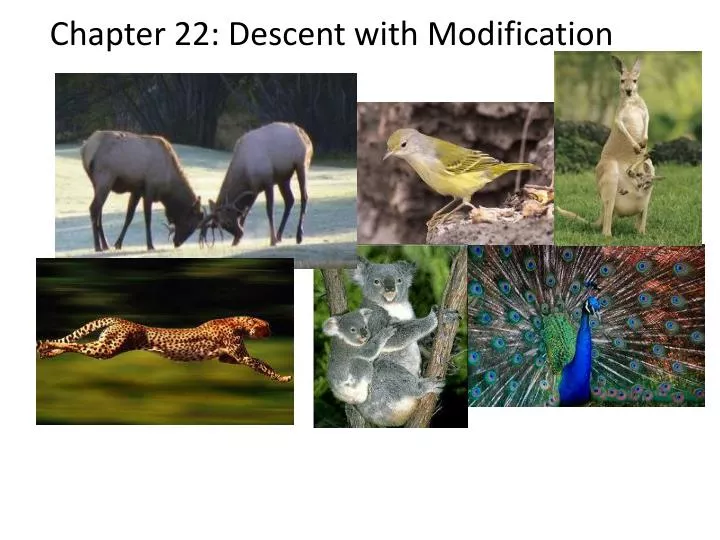
Chapter 22: Descent with Modification
Download Presentation
Chapter 22: Descent with Modification
- - - - - - - - - - - - - - - - - - - - - - - - - - - E N D - - - - - - - - - - - - - - - - - - - - - - - - - - -
Presentation Transcript
-
Chapter 22: Descent with Modification
-
Theory of Evolution • Change through time • Descent with modification • Genetic changes of a population through time • Explains Biodiversity • Variety of life forms, with adaptations to specific environments • Form=Function • Explains relationship between living organisms • How organisms are related past descent from common ancestors
-
Theory of Development • Pattern of Evolution • Observations from natural earth • Nerveless from variety of fields • Biological science, geology, physics, chemistry • Procedure of Evolution • Mechanisms causing change • Unifying theory of biology • Explains and connects observations from natural world
-
Types of Evolution • Microevolution= change in the gene pool of a population over many generations • 4 Methods of Microevolution • Mutations • May be deleterious or neutral • Natural Selection • Process in which individuals with favorable inherited traits are more than probable to survive and reproduce • Genetic Migrate= chance events cause genetic changes from one population to the next • Gene Menses= individuals or gametes move to a different population
-
Natural Pick and Mutation
-
Nomenclature of Species • Before 1700s, major belief was organisms did not modify through time simply were "perfect" and "permanent" • Greek philosopher Aristotle= arranged species on a scalanaturae • Elementary to complex • Viewed species equally fixed, not-changing • 1700s: Carolus Linnaeus= founder of taxonomy • Branch of biology concerned with classifying organisms • Developed the binomial format for naming species • Homo sapiens
-
Classification of Species • In the mid-1700s, studies of fossils plant evidence of life-forms different from those currently living • Early 1800s, French naturalist Jean Baptiste Lamarck explained the differences in fossil records by proposing organisms evolved through time
-
Fossil Record • Primarily based on imprints or remains left in sedimentary rock • Relative ages of fossils can exist adamant based on their position in rock layers • Radiometric dating allows for more precise crumbling of fossils • Whole organisms tin as well exist preserved in mediums preventing decomposition • Insects in resin • Wooly mammoth frozen in ice • Documents change of organisms through fourth dimension • Documents large number of extinct species
-
Classification of Species • Lamarck proposed: • Organisms could modify its traits by using or not using certain body parts • These changes could be passed to offspring • Non supported by genetics
-
Charles Darwin • Built-in in 1809 • Life-long naturalist • After college, joined the crew of the HMS Beagle to explore and map parts of the South American coastline • Collected specimens of South American plants and animals HMS Beagle in port
-
Charles Darwin: Voyage of HMS Beagle Uk EUROPE Due north AMERICA ATLANTIC OCEAN The Galápagos Islands AFRICA Equator Malay Archipelago Southward AMERICA PACIFIC OCEAN Brazil Republic of chile AUSTRALIA PACIFIC OCEAN Andes Mtns. Greatcoat of Good Hope Argentina Tasmania Cape Horn New Zealand
-
Figure 22.5c The Galápagos Islands PACIFIC Bounding main Pinta Genovesa Marchena Equator Santiago Daphne Islands Pinzón Fernandina Isabela Santa Cruz Santa Fe San Cristobal 0 20 40 Florenza Española Kilometers
-
Charles Darwin • During voyage, made 2 important observations: • Animals and plants had characteristics specific to the environment they inhabited • Organisms on islands were similar simply unlike from organisms on mainland • Darwin perceived adaptation to the environment and the origin of new species as closely related processes
-
Figure 22.six (b) Insect-eater (a) Cactus-eater (c) Seed-eater
-
Charles Darwin
-
Charles Darwin • 1844: wrote an essay on natural choice as the mechanism of descent with modification • Did non introduce his theory publicly • 1858: Received manuscript from Alfred Russell Wallace • Adult a theory of natural option like to Darwin's • Darwin quickly finished The Origin of Species and published it the next yr
-
Charles Darwin • 1859: The Origin of Species was published • Provided prove of "descent with modification" • Current species came from a succession of ancestors • As descendants spread into new habitats, modifications (adaptations) accumulated as a result of new environmental factors • Resulted in new species and increased diversity • Proposed mechanism for development • Natural option
-
Charles Darwin • In the Darwinian view, the history of life is like a tree with branches representing life's diversity • Darwin's theory meshed well with the hierarchy of Linnaeus
-
Hyracoidea (Hyraxes) Figure 22.8 Sirenia (Manatees and relatives) †Moeritherium †Barytherium †Deinotherium †Mammut †Platybelodon †Stegodon †Mammuthus Elephas maximus (Asia) Loxodonta africana (Africa) Loxodonta cyclotis (Africa) threescore 34 24 v.five 2 104 0 Years agone Millions of years ago
-
Bogus Option • Darwin noted that humans have modified other species by selecting and breeding individuals with desired traits • Artificial selection
-
Figure 22.ix Cabbage Selection for upmost (tip) bud Brussels sprouts Pick for axillary (side) buds Broccoli Selection for flowers and stems Selection for stems Pick for leaves Kale Kohlrabi Wild mustard
-
Darwin drew two inferences from two observations • Observation #1: Members of a population often vary in their inherited traits • Inference #1: Individuals whose inherited traits give them a higher probability of surviving and reproducing in a given environment tend to go out more than offspring than other individuals
-
Darwin drew two inferences from two observations • Observation #ii: All species can produce more offspring than the environment tin support, and many of these offspring fail to survive and reproduce • Inference #ii: This unequal ability of individuals to survive and reproduce will lead to the accumulation of favorable traits in the population over generations
-
Natural Selection • Unequal reproduction is the essential part of natural selection • Individuals with characteristics allowing them to be better at… • getting nutrient • escaping predators • tolerating environment • alluring mates • …will survive longer and potentially produce more offspring with the adaptive characteristic
-
Natural Selection • Explains the match between organisms and their surround…
-
3 Key Points to Evolution by Natural Selection • Individuals do not evolve, populations evolve • Evolution occurs equally adaptations accumulate in populations over several generations • Natural option but works on heritable traits with variation in the population • Acquired traits are non passed to offspring • Development is not working towards a specific goal or "perfect" organisms • Natural option results from an organism interacting with a specific environment • Characteristics favorable in i environment may non be favorable in another
-
Natural Selection: Summary • Individuals with sure heritable characteristics survive and reproduce at a higher rate than other individuals • Natural selection increases the accommodation of organisms to their surroundings over time • If an environment changes over time, natural selection may effect in adaptation to these new conditions and may give rise to new species
-
Evidence of Natural Selection: Response to Introduced Establish Species • Soapberry bugs apply their mouthparts to feed on seeds within fruits • Southern Florida: feed on balloon vine with large fruit • Longer beaks • Central Florida: feed on goldenrain tree with modest fruit • Shorter beaks • Correlation between fruit size and beak size besides observed in Louisiana, Oklahoma, and Commonwealth of australia Soapberry problems with beak inserted in balloon vine fruit
-
RESULTS Figure 22.13b Beak ten On native species, southern Florida 8 6 4 ii 0 Number of individuals Museum-specimen average 10 On introduced species, central Florida 8 vi iv 2 0 6 7 8 9 ten 11 Beak length (mm)
-
Testify of Natural Selection: Response to Introduced Plant Species • In all locations, nib size has evolved in populations that feed on introduced plants • Fruits smaller or larger than native fruits • Evolution by natural pick • In Florida, this development in beak size occurred in less than 35 years
-
Evidence of Natural Choice: Antibiotic resistant bacteria • Staphylococcus aureus is commonly establish on people • S. aureus became resistant to penicillin in 1945, two years subsequently it was beginning widely used • One strain, methicillin-resistant South. aureus (MRSA) is a dangerous pathogen • S. aureus became resistant to methicillin in 1961, two years after information technology was first widely used
-
Evidence of Natural Selection: Antibiotic resistant bacteria • Methicillin= inhibits a protein used by bacteria in their jail cell walls • MRSA bacteria use a different poly peptide in their cell walls • When exposed to methicillin, MRSA strains are more likely to survive and reproduce than nonresistant S. aureus strains • MRSA strains are now resistant to many antibiotics
-
Evidence of Natural Choice: Antibiotic resistant bacteria Antibiotic Practical Reproduction Final population composed of loftier resistance strains Nearly bacteria killed, High resistance strains remain
-
Evidence of Natural Selection: Antibody resistant leaner • Natural selection does non create new traits • Works on existing traits already nowadays in the population • Mutations are raw material for natural selection to act on • Local environment determines which traits will be selected for or selected against in any specific population
-
Evidence of Natural Selection: Comparative Anatomy • Homology= like characteristics resulting from a mutual ancestor • Homologous structures= similar structure in features even if function is different • Instance: Vertebrate Forelimbs
-
Figure 22.15 Humerus Radius Ulna Carpals Metacarpals Phalanges Bat Whale True cat Human being
-
Show of Natural Pick: Comparative Anatomy • Comparative embryology reveals anatomical homologies non visible in adult organisms
-
Evidence of Natural Selection: Comparative Beefcake • Vestigial structures= remnants of features with served of import functions in the organism's ancestors
-
Evidence of Natural Selection: Molecular Biology • Homologies as well occur at the molecular level • Genes shared among organisms inherited from a common ancestor
-
Evidence of Natural Selection: Molecular Biology • Evolutionary history independent in an organism'southward Dna • Closely related species volition accept more than similarities in Dna than distantly related species • Darwin proposed all life forms are related • Supported by molecular biology • All organisms use same genetic language- Dna and RNA • Same genetic code for near all organisms • Humans and bacteria share homologous genes
-
Evidence of Natural Selection: Evolutionary Trees • Evolutionary copse= hypotheses nigh the relationships among unlike groups • Class nested patterns in evolutionary trees • Made using different types of data • Anatomical similarities • Deoxyribonucleic acid sequence data
-
1 iii 2 five 4 6 Effigy 22.17 Branch bespeak Lungfishes Amphibians Tetrapods Mammals Digit-bearing limbs Amniotes Lizardsand snakes Amnion Crocodiles Homologouscharacteristic Ostriches Birds Feathers Hawks andother birds
-
Prove of Natural Selection: Evolutionary Trees • Convergent evolution= evolution of similar, or analogous,features in distantly related groups • Arise when groups independently accommodate to similar environments in similar ways • Convergent evolution does not provide information about ancestry
-
Bear witness of Natural Selection: Biogeography • Biogeography= geographic distribution of species • Island animals resemble species on closest mainland more than than they resemble species on islands closer and further away • Explanation: Animals on islands migrated from mainland, natural selection inverse animals over time into divide species • Galapagos Finches • Marsupials in Australia
-
Testify of Natural Option: Biogeography • Alfred Russel Wallace (1823–1913) • Father of biogeography • Best known equally the co-discoverer of the principles of natural selection with Darwin • Main contribution was the written report of species distributions beyond large spatial scales
-
Evidence of Natural Choice: Biogeography • Wallace (1860) observed that animals can vary considerably over very short distances • Could not exist explained until continental drift was proposed • Continental migrate from movement of Earth'due south plates explains the distributions of some species • Blazon of macroevolution
-
Types of Development • Macroevolution= change in groups above the level of species, often results in new taxonomic groups • Methods of Macroevolution • Adaptive radiation= periods of modify when many new species originate from a common ancestor • Mass extinctions= big number of species go extinct within a relatively short amount of fourth dimension • 5 mass extinctions have occurred through geological time with 50% or more species lost • Plate tectonics and Continental drift= movement of Earth's plates
-
Mass Extinction Event Mass Extinction Upshot
Source: https://www.slideserve.com/adam-monroe/chapter-22-descent-with-modification
0 Response to "Chapter 22 Descent With Modification Reading Guide Answer Key"
إرسال تعليق